In 2014, David S. Pedulla found that black gay men would receive salaries similar to their straight male counterparts due to what he identified as "privilege" [1]. Although being black made a man seem more aggressive, being gay made him seem more effeminate. So, being black and gay seemed to "cancel out" and result in salaries that were higher than straight black men and gay white men.
Reading this study by Dr. Pedulla and the reflections by gay black men writing about the study, I began to realize that the issue here is in our definition of privilege. No one wants to be hired just because they are white, gay, female, or otherwise labeled.
Privilege, as a useful definition for achieving equality, is not primarily about material benefits. Privilege is being seen and treated as an individual.
When you are seen and treated as an individual, rather than a box, you are more likely to be valued for your skills.
Whether or not these findings are generally representative, they point to a larger misunderstanding in our conversations about privilege and economic fairness. Most definitions of privilege include some mention of economic injustice and prejudice, but most fail to boil privilege down to the basic fact that it stems from how humans think. These black gay men benefited from prejudice, but were still experiencing prejudice due to stereotypes.
Stereotypes (the taking away of privilege) are a form of mental heuristic used to make decisions quickly. In the book Thinking Fast and Slow, Daniel Kahneman writes of the basic cognitive biases humans use resulting in irrational or biased every day decision-making. The availability heuristic, for example, means that people will draw fallacious or incorrect conclusions about probabilities, relationships, and results because of prominence of examples. People will underestimate the number of words that contain the letter K because they try to think of words that start with K and can't remember words containing K. People will overestimate the likelihood of death in a dramatic news-worthy event like a tornado or terrorist attack instead of more likely events, such as drowning in a pool or a car accident.
Similarly, it's much easier to think of a variety of white men who have made brilliant contributions to the economy than it is to think of women or people of color or non-westerners. It's easier to think of someone who is more often in a place of prominence (i.e. the first letter in a word). To think of a woman or person of color, you have to focus on that attribute. Minorities are seen first as minorities, and as their profession or individuality second.
As a result, minorities are often aware that their performance may reflect on others who share their sex, gender, sexual orientation, race, or other minority feature. As in this XKCD comic.
Similarly, it's much easier to think of a variety of white men who have made brilliant contributions to the economy than it is to think of women or people of color or non-westerners. It's easier to think of someone who is more often in a place of prominence (i.e. the first letter in a word). To think of a woman or person of color, you have to focus on that attribute. Minorities are seen first as minorities, and as their profession or individuality second.
As a result, minorities are often aware that their performance may reflect on others who share their sex, gender, sexual orientation, race, or other minority feature. As in this XKCD comic.
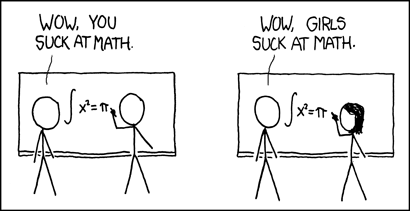 |
| Thanks, Randall Monroe for sharing work from XKCD.com |
I believe availability and similar heuristics are at play when we discuss privilege. Consider this anecdotal experience that I had at a Starbucks. I went to the Starbucks, and noticed it was full of people. When I began to look for a table, I recognized two men as being gay. I then realized that many of the customers seemed to be men, and that I was the only woman in the Starbucks. Why, before recognizing the two men as gay, did I not realize everyone was a white man earlier?
My thesis is that because of mental heuristics and places of prominence (i.e. privilege), white male is the default image of an individual for many Americans. We don't notice when someone is a white male as often, because we expect it. This thesis is also the basis of the WWE video with John Cena describing the average american.
The average American is a woman, but women are not as often in places of prominence/privilege. When we see white men, people who are more often in places of prominence/privilege, we see individuals. Once that white man is labeled as disabled, gay, a hillbilly, or some other stereotype, he loses part of that "privilege." In support of this theory of privilege, we also see that when starting to discuss privilege (white male or not) there is a backlash because part of that privilege is lost. No one wants to be called privileged, because it removes a part of their individual identity and individual accomplishments and struggles.
I'm ashamed and embarrassed that I had to focus on "otherness" of sexual orientation to have that realization in the Starbucks. But every time we recognize these impulses and stereotypes, we can do something to stop using those stereotypes as assumptions in our choices and actions. We can re-train our brains.
I'm ashamed and embarrassed that I had to focus on "otherness" of sexual orientation to have that realization in the Starbucks. But every time we recognize these impulses and stereotypes, we can do something to stop using those stereotypes as assumptions in our choices and actions. We can re-train our brains.
Understanding these roots of privilege is necessary to understand the importance of affirmative action. Justice Clarence Thomas once put a fifty-cent sticker on his Yale diploma [3], because potential employers assumed he didn't earn his grades or degree. They assumed he was a result of affirmative action taken by Yale to enroll men of color. He felt that they questioned him because of affirmative action, but our understanding of privilege indicates that they questioned him because of the color of his skin. Affirmative action was just a convenient excuse or rationalization.
It may very well be the case that Justice Thomas was only admitted to Yale because of affirmative action, but that does not mean he was not qualified or that he would not have been admitted if he were white. It's possible that Yale only even saw Justice Thomas's credentials because of affirmative action. Yale is not going to admit a random person off the street to fill a quota. That's not what affirmative action is about.
Affirmative action is about correcting for the years of stereotypes that hold people back in the talent pool. Affirmative action and the whole range of outreach efforts starting in pre-school are purely about making sure that the best minds reach their economic potential. The goal of affirmative action is to eventually make itself irrelevant (which will take a very long time). If all you can see is a group of black men, black women or white women or other appearance - then perhaps you aren't seeing the individuals.
[1] Michael Hotchkiss, 2014, "Negative stereotypes can cancel each other out on résumés", Princeton University. https://www.princeton.edu/main/news/archive/S40/00/87A28/index.xml?section=topstories
[2]Amos Tversky & Daniel Kahneman, 1973, "Availability: a heuristic for judging frequency and probability", Cognitive Psychology. https://people.umass.edu/biep540w/pdf/Tversky%20availability.pdf
[3] Robert Barnes, 2012, "Clarence Thomas and Yale begin to repair relationship", Washington Post. https://www.washingtonpost.com/politics/clarence-thomas-and-yale-begin-to-repair-relationship/2012/05/31/gJQADKyK5U_story.html?utm_term=.cf57ae3de601
[2]Amos Tversky & Daniel Kahneman, 1973, "Availability: a heuristic for judging frequency and probability", Cognitive Psychology. https://people.umass.edu/biep540w/pdf/Tversky%20availability.pdf
[3] Robert Barnes, 2012, "Clarence Thomas and Yale begin to repair relationship", Washington Post. https://www.washingtonpost.com/politics/clarence-thomas-and-yale-begin-to-repair-relationship/2012/05/31/gJQADKyK5U_story.html?utm_term=.cf57ae3de601
Comments
Post a Comment